
Qualified Electronic Signatures: Enabling EU Business from Anywhere
How to make QES and start using?
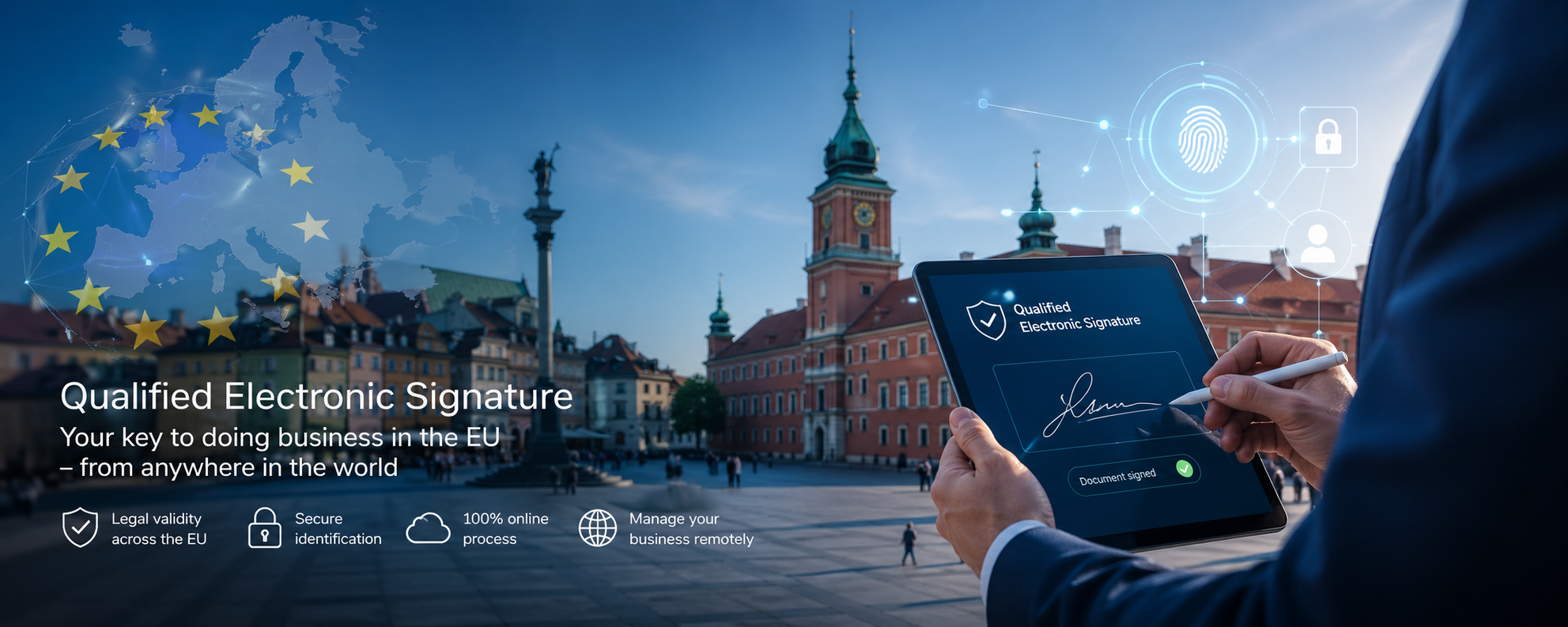
A qualified electronic signature (QES) is the highest-trust form of e‑signature defined by the EU’s eIDAS Regulation (EU 910/2014). By law it carries the same legal effect as a handwritten signature across all EU member states. In other words, a document signed with a QES is as valid in court or administration as one signed on paper.
EU law also mandates that each country must recognize a QES issued in another member state. This means any EU‑qualified signature (sometimes called “eIDAS 2.0” QES) is trusted Europe‑wide. For foreign entrepreneurs, many providers now allow 100% online issuance of QES – for example UniStyle’s EC‑Signer service supports citizens of 180 countries (including non‑EU nationals) without any in‑person or notary visits. After a quick remote video ID check (using just a passport and smartphone), the signature key is installed on your phone or PC, so you can sign legally from anywhere.
Legal Status and EU Recognition
Under eIDAS, no one may demand a higher form of signature than QES for public services, and QES cannot be denied legal effect just because it’s electronic. In practice this means:
- Equivalent to Handwritten Signature: A QES “shall have the equivalent legal effect of a handwritten signature”. Many EU countries (including Poland) explicitly treat QES as fully replacing a pen‑and‑paper signature. (It requires a qualified certificate from a certified trust provider and a secure signature device, which provides unique identification of the signer.)
- Cross‑border Validity: Any QES based on an EU-qualified certificate is automatically recognized in all other EU states. You do not need a separate local signature when doing business across Europe – an EU QES will be accepted everywhere.
Because of this, a QES is often required or highly preferred for formal EU transactions. For example, EU rules forbid member states from demanding a “higher” signature for public services than a QES. In effect, QES is the gold standard for signed documents in Europe.
Why QES Matters for Business in the EU
For Middle Eastern (and other non‑EU) entrepreneurs running a company in the EU – especially Poland – a qualified e‑signature is extremely useful and sometimes indispensable. It unlocks fully digital operations and saves time and travel. Notable use cases include:
- Company Registration and Filings: You can use a QES to register a company or file official documents without visiting an office. For instance, with a Polish QES you can use online systems like S24 or CEIDG to register a business or sign a financial report. Annual accounts, board resolutions, and corporate filings can be prepared and signed digitally. In fact, many corporate documents (e.g. financial statements of limited liability companies) must be submitted with a qualified or other trusted signature.
- Tax and Social Security: Most Polish tax and social declarations (e.g. ZUS – social insurance – forms, or JPK tax audit files) are filed online. A QES lets you sign these legally from abroad. It also works with newer systems like KSeF (the national e‑invoicing system) and CEIDG/KRS (the Central Business Registers), which require certified signatures.
- Public Administration and e‑Government: Services like ePUAP (government portal), e-Correspondence (official email box), e-Court filings, and other e-government processes all accept QES. In Poland, for example, foreigners without a local ID number (PESEL) rely on QES to submit ePUAP requests or apply for an e‑mail inbox with authorities. A qualified signature is effectively a universal key to Poland’s online public services, even for non-citizens.
- Contracts and B2B Transactions: Many EU companies and public tenders require or prefer signed electronic contracts. A QES allows you to securely sign B2B/B2C contracts, sales proposals, purchase agreements, and HR documents (e.g. employment contracts, orders, internal minutes) from anywhere. It provides strong proof of authenticity and integrity, which reassures partners. In Poland, for years public procurement bids have been submitted only electronically, and a QES is needed for a valid tender submission. Qualified signatures also streamline invoice approval and cross-border trade: e‑invoices and contracts can travel instantly without notarized wet signatures.
- Convenience and Compliance: A QES is not only for businesses – it can be used for any formal document. You can sign rental agreements, notarial applications, power‑of‑attorney forms, court filings, and more. Because of its legal weight, QES ensures compliance with EU rules for electronic documentation. And it’s much safer than a scanned image of a signature, since it uses cryptography: documents signed with QES cannot be forged or altered without detection.
In summary, a QES saves time and money by avoiding paperwork and travel. It “opens the door to full‑fledged participation in the digital world of government and business”. It provides legal certainty (equivalent to hand‑written signature) and cross‑border validity, making it ideal for managing an EU company remotely.
How to Obtain and Use a Qualified Signature?
Fortunately, the entire process can now be done online, even from outside the EU. Most providers follow these steps (illustrated in UniStyle’s EC‑Signer service):
- Remote Identity Verification: You apply online and upload your passport. In a brief video call (or via advanced AI checks), a certified agent verifies your identity. No in‑person meeting or local notary is needed.
- Activation and Software: Once approved, you receive an activation code and install signing software. Modern QES services often use a mobile app (no physical card needed) that holds your signature keys in the cloud or on your phone. This means you can sign documents from any device (phone, tablet or PC) by confirming with a one-time code (two-factor authentication).
- Signing Documents: The applications support EU signature standards (e.g. XAdES for XML, PAdES for PDFs), so you can sign invoices, contracts, forms, etc. simply by uploading them to the app or an approved web portal. The digital signature is then embedded into the PDF or XML and is legally valid.
Key requirements are minimal: usually just a valid passport or ID, a smartphone (iOS/Android), and a computer with internet. After about 30 minutes of online verification, the qualified certificate is issued (for 1–3 year term). From that moment, you can control your EU company fully online – submit forms to any Polish or EU administration, sign contracts, file taxes, etc., all from your home country. If your phone is lost or changed, two-factor protection and recovery procedures keep your signature secure.
Practical Tips for Middle Eastern Entrepreneurs
- Choose a Recognized Provider: Use a trust service provider certified under eIDAS (like UniStyle/EuroCert, Certum, etc.), as their QES will be trusted in the EU. Check that they support your nationality (many list countries like Egypt, UAE, Vietnam, Saudi Arabia, Bangladesh, Qatar, Azerbaijan, Albania, etc.).
- Plan for e-Registration: If you will incorporate or have a company in Poland, obtain QES early. For instance, it lets you register a company or file KRS and CEIDG paperwork online. Without it, you might need a local proxy or letter of attorney.
- Use it in Official Portals: Once you have a QES, link it to your profiles on Polish/EU portals (S24 corporate register, ZUS PUE, tax office online, etc.). Then you can submit declarations and data directly. For example, signing and transmitting an electronic tax report (JPK) or ZUS declaration is straightforward.
- Keep Backups: As with any digital certificate, save your activation codes or backup tokens securely. Most providers allow easy renewal or issuance of a new QES when the old one expires, again fully remotely.
- Understand Alternatives: In some cases you may hear of “trusted profiles” or national e-ID, but these often require local residency. A QES is truly global – it does not require EU citizenship or ID. EU law even envisions a future “digital wallet” (eIDAS 2.0) to make QES free and ubiquitous, but in the meantime commercial QES services fill the gap for international business.
Conclusion
Qualified electronic signatures empower Middle Eastern and international entrepreneurs to run EU companies without ever setting foot in Europe. Because they meet strict eIDAS standards, these signatures let you complete any formal procedure that requires a written signature – from registering a company and filing taxes, to signing contracts and participating in tenders – entirely online. They combine legal certainty (equivalent to pen‑and‑paper) with modern convenience (remote issuance and mobile signing). For anyone doing business in Poland or the EU, a QES is often not just convenient but essential.